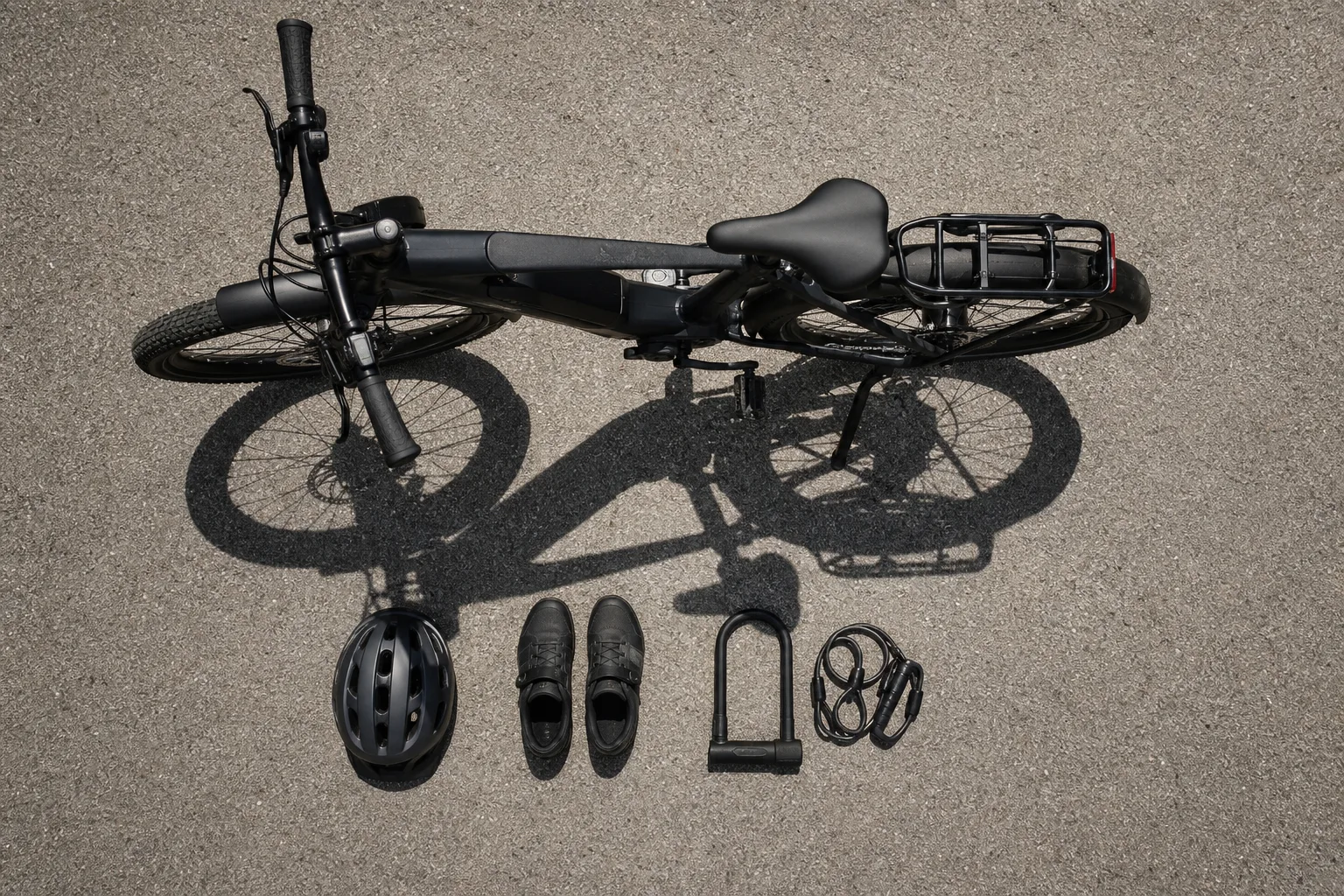
Most test rides are a loop of the parking lot with the assist turned up, which flatters every bike ever built and tells you almost nothing about the one you are considering buying. A motor covers for bad gearing, bad weight distribution and an awkward reach. Twenty minutes is enough to strip that cover away, provided you spend it on the specific moments where an electric bike is different from a regular one: getting on, going slowly, moving it without power, starting on a grade, and stopping with weight aboard. Run these in order and ask the shop for the space to do it.
Mount from the curb, not from flat ground
Standing in an open lot, you can straddle almost anything by leaning the bike a few degrees. At the curb you cannot, because your supporting foot is four to six inches above the road and the bike is down in the gutter, which is exactly how you will mount it outside a grocery store for the next five years. Swing a leg over from that position with your usual shoes on. If your inseam clears the top tube with an inch or so to spare and you are not tipping the bike to make it happen, the stand-over is honest. If you have to rock it, the frame is too tall regardless of what the size chart says.
Ride a slow, tight turn with the assist off
Find a painted parking space and circle inside it at walking pace, no motor. This is where a heavy front end and a slack head angle announce themselves: the bar wants to flop toward full lock, the bike leans into the turn faster than you asked, and you correct with a jab of the handlebars. A bike that does this feels fine at fifteen miles an hour and unpleasant in a crowded bike lane or a driveway. Steady, boring, unhurried low-speed steering is worth more than any spec on the tag. It rules out a bike you will avoid using in traffic.
Push it thirty feet with the power off
Walk the bike, motor off, on the flat, then turn it around in a space the width of a hallway. You are learning what happens on the day the battery is empty, the day it is in the back of a car, and every day you move it past a doorway. Notice where the weight sits: a rear hub with a rack battery pushes very differently from a mid-drive with the mass low and central. Notice whether the pedals hit your ankles as you steer. If pushing it is a chore, storing it will be worse.
Do one hill start from a dead stop
Not a rolling hill, a stop. Squeeze the brakes halfway up the steepest grade near the shop, put a foot down, then start again in whatever gear you happened to be in. What you are testing is the lag between your first pedal stroke and the motor arriving, and whether the assist comes in smoothly or shoves. Cadence sensors typically need most of a crank rotation; torque sensors respond sooner. Either can work. A half second of freewheeling while you wobble into an intersection is the thing that rules a bike out.
Brake with weight in the panniers
Ask the shop to put twenty or thirty pounds in the bags or on the rack, then brake hard from about fifteen miles an hour, and again slowly on a downhill. Loaded stops are the ones that matter, since a bike that stops well empty can feel vague with groceries on the back. Listen for a lever that comes near the bar and feel for whether the rear steps out. The Consumer Product Safety Commission oversees bicycle brake requirements in the United States, but the useful test is the one you run yourself, with the load you actually carry.
Do all five on every bike on your short list, in the same order, on the same afternoon if you can. The comparison is what makes them worth doing, and it usually settles the decision faster than another week of reading spec sheets.