The unupgradeable part
Motors, batteries, saddles and tires can all be swapped later. Frame geometry cannot, which is why it deserves the most attention before money changes hands.
It describes how far behind the pedals your saddle sits. Slacker means a more upright, armchair position; steeper puts your weight over the cranks for better standing leverage.
Stand-over height, seat tube angle and battery placement govern daily use more than motor specs do, and each frame style charges a different price for the convenience.
Motor wattage gets the headline on every spec sheet, and it is the least useful number for predicting whether a bike ends up in daily rotation or parked behind the recycling bins. What decides that is far duller: how high you have to lift a leg to get aboard, where your hips sit relative to the pedals, and whether a forty-pound machine stays balanced when you stop at a light with a bag of groceries hanging off the bars. Frame shape governs all three. It also cannot be upgraded later, which is why the choice deserves more scrutiny than the drivetrain.
The classic fitting advice, straddle the top tube and check for clearance, was written for a twenty-two pound road bike that you could hop onto in one motion. Electric bikes weigh two to three times that, and the consequence of a clumsy dismount is a heavier object falling on your shin. More to the point, stand-over height sets the effort tax on every single trip. If mounting requires a swing of the leg over a rear rack loaded with a child seat, panniers, or a case of seltzer, you will find reasons not to ride for the short errands, which are exactly the trips an e-bike is best at replacing. Low stand-over does not make you a better rider. It removes the friction that quietly kills the habit.
The angle of the seat tube, meaning how far back or forward the saddle sits over the bottom bracket, is the geometry number almost nobody checks and almost everybody feels. A slack angle, further back, pushes you into a more upright, chair-like position with the pedals ahead of your hips, comfortable at low speeds and easy on the wrists, but it loads the saddle heavily and gives you less leverage when you stand up to clear a curb cut. A steeper angle puts your weight over the cranks, which suits riders who still want to contribute real effort on hills. Neither is right. The question is whether the bike's fit matches the way you actually ride, and a store demo of ten minutes will tell you more than any chart.
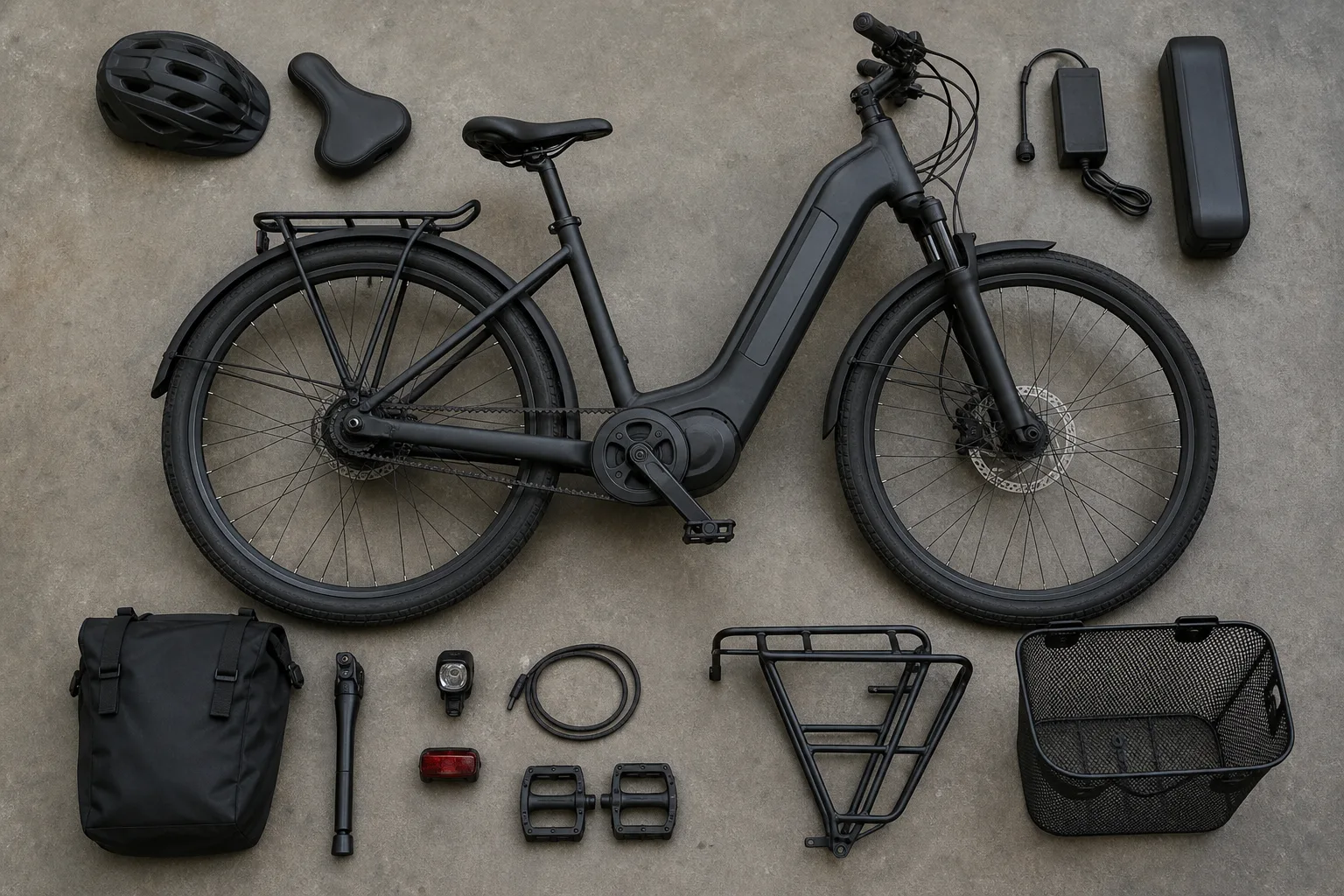
Battery placement is the hidden constraint behind every frame decision, because a pack weighing roughly fifteen pounds has to live somewhere structural. Integrated into the down tube, it sits low and central, the best possible spot for handling, and it usually forces a diamond or near-diamond shape to carry the load. Mounted on top of the down tube, it is easier to remove for charging indoors but raises the center of gravity slightly. Placed behind the seat tube or inside the rear rack, it frees the frame's middle entirely, enabling a genuinely low step-through, at the cost of putting weight high and far back, which is felt most when the bike is at walking pace or being lifted onto a rack.
An open frame, with no top tube at all and a down tube that curves toward the ground, gives the lowest possible entry and the widest tolerance for skirts, work clothes, orthopedic limits and cargo already strapped to the back. What it gives up is torsional stiffness. Without a triangulated front section, builders compensate with a fatter, thicker down tube, which adds weight, and even then a heavily loaded open frame can feel slightly vague in a fast corner. Manufacturers know this, and the better ones publish a total capacity rating that accounts for it; the Consumer Product Safety Commission oversees bicycle construction requirements in the United States, so that rating is not decorative. A well-designed step through ebike solves the stiffness question with tube shaping and a low, wide bottom bracket junction rather than by asking the rider to lift a leg higher.
A low frame, sometimes called mid-step or trapeze, runs a top tube that slopes sharply down and meets the seat tube near the bottom. It restores most of the triangle, so it is stiffer than an open frame and carries a rear load with less flex, while still cutting stand-over by six or eight inches compared with a traditional build. The compromise is real but modest: you still swing a leg, just a shorter one, and some cargo setups will interfere. This is the shape that suits riders who want carrying capacity without the full gymnastic requirement.
A diamond frame keeps the complete front triangle, which buys the most stiffness per pound, the cleanest battery integration and the broadest accessory compatibility. It also holds value best on the used market, because the buyer pool is largest and the shape reads as conventional. What it costs is exactly what the other two are buying: easy mounting. If your commute involves frequent stops, tight bike room storage, or a body that objects to high leg swings, that stiffness advantage is theoretical and the mounting penalty is daily.
Price the trade honestly. Stiffness and resale are worth something on the day you sell; a low stand-over is worth something every morning, and only one of those shows up on the spec sheet.